
👴 The richest retiree launches an AI startup, 🪦 Microsoft buries SaaS, 🧟 Deadbots go mainstream, and ⑵ Dario bets on doubled lifespans

November 20, 2025. Inside this issue:
• Dead relatives become a mobile app product, not a Black Mirror episode
• Microsoft switches the world from “per user” to “per agent” and squeezes SaaS
• The richest retiree comes back with a 6.2 billion dollar AI bet on physical reality
• Dario Amodei says AI will double human lifespan and kill half of entry level office jobs
👴 The richest retiree decides to launch an AI startup
✍️ Essentials
Imagine this: you are happy that at least one dollar billionaire grandpa has gone into semi retirement, plays with rockets, posts yacht photos, and the rest of us can quietly build AI startups without him stepping on the same field.
And then Bezos climbs out of this “rest”, picks up 6.2 billion dollars, and basically says: I am back and I am here to rewrite engineering and manufacturing.
Here is what actually happened.
The New York Times writes that Jeff Bezos is officially returning to operations as co CEO of a new AI startup called Project Prometheus. This is his first real executive role since 2021, when he left the CEO position at Amazon.
The startup immediately launches with 6.2 billion dollars in early funding. Part of that is Bezos’s own money. This is one of the most heavily funded early stage AI projects in the world.
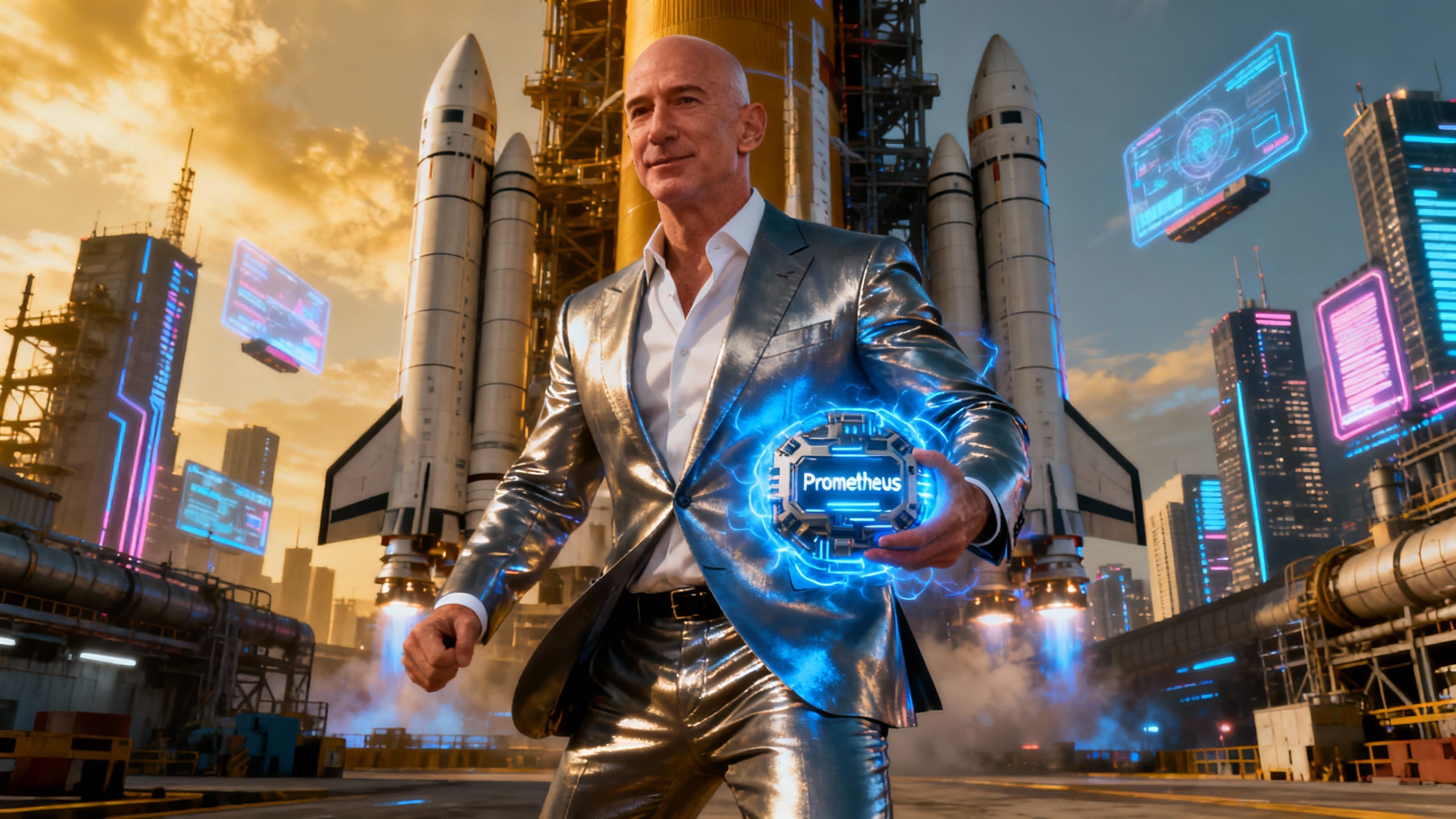
Prometheus focuses on AI that learns from the physical world: engineering, manufacturing, the “world for robots”, not just text and images. The plan is software for design and factories in computing, automotive, and space, plus things around world models, robotics, and scientific discovery.
The team is already almost 100 people. About half have been poached from OpenAI, DeepMind, Meta, and other top labs. So this is not a lab in a garage. This is direct brain pumping from the frontier of AI.
The second co CEO is physicist and chemist Vik Bajaj, ex Google X and co founder of Verily at Alphabet. So the bundle is “money + Amazon grade operator + scientist with a moonshot background”.
On top of all this, Elon, in his usual fashion, came out on X and called Bezos a copycat for making yet another AI startup. The market was clearly told: this is a war of old billionaires, not just some random YC project.
Context for the market.
Prometheus is aiming at AI for the physical economy - the space where CAD, MES, PLM, digital twins, robots, and custom factory simulations live today. It is the heaviest, most expensive, most conservative piece of the AI market. Usually startups go there by picking one narrow workshop niche.
Flying in there with a 6.2 billion dollar check on day one is the level of “we want to be the new standard for engineering and production”, not just an assistant next to an engineer. It is a bet against a pile of fragmented vendors with licenses and 12 month integration cycles.
For Blue Origin this looks like an ideal booster: AI for design and production of hardware, rockets, engines, materials is a direct amplifier of the space story. The whole ecosystem around space, automotive, and heavy industry understands this and will watch Prometheus as a potential “new OS” for the shop floor.
🐻 Bear’s take
For business: if you have any hardware, production, logistics, or complex engineering, you should assume that in a couple of years people from Prometheus will come to your leadership and say: let us redraw your entire development cycle and factory under AI. Your defense is your data, your own models, and your own fast pilots right now.
For investors: the ticket to “physical AI” has officially been lifted into orbit. A 6.2 billion dollar starting check cuts off a lot of weak stories on this field, but opens windows for niche players in materials, specific factory types, safety, and tooling on top of a giant like this. The one question will be: do you complement Prometheus, or do you risk being eaten by it.
For people: engineers, technical staff, and operations people are heading toward much harder automation. Not just an assistant that writes documentation, but systems that propose schemes, modes, and sequences of operations. A career of “I click the same CAD for 20 years and live calmly” is now officially in doubt.
🚨 Bear in mind: who is at risk
Vendors of industrial software and mid sized engineering integrators - 8/10
Because you are now up against a project with 6.2 billion dollars, the Bezos brand, and a pack of people from OpenAI and DeepMind. What to do - go into deep niches, build your own AI modules, and tie yourself to specific customer data instead of box license models.Countries and corporations that have not figured out AI for the physical economy - 7/10
Because they risk ending up hooked on a couple of American platforms for factory and engineering control. What to do - launch your own industrial AI centers, build local teams, and avoid handing all engineering data to someone else’s stack.
🪦 Microsoft buries SaaS and office workers
✍️ Essentials
Not long ago I already wrote that classic SaaS will not live long. No team can physically keep up with the update speed that AI and your business now require.
And then Satya walked up to the mic on Dwarkesh Patel’s podcast and buried the rest of the market.
Here is what actually happened.
Nadella formulates a new success metric for AI: not the growth of Microsoft’s market cap, but the growth of the economy and society. It sounds humane, but underneath sits a new money model.
Under this philosophy he tunes the Microsoft AI superfabric: data centers, hardware, models, and the entire stack for a world where not humans, but swarms of autonomous agents create most of the load.
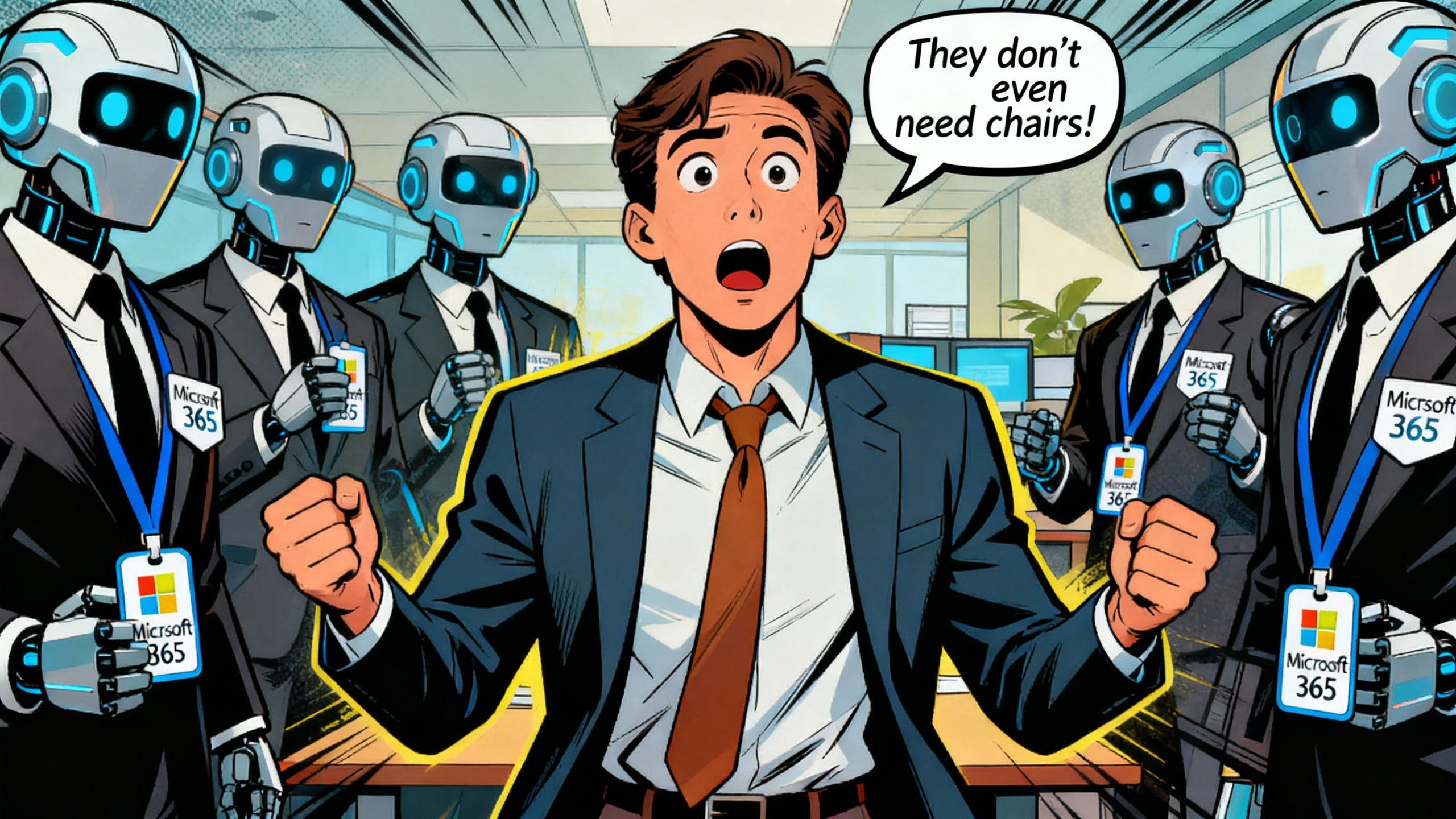
In the conversation with Dwarkesh he says it directly: Microsoft is moving from “per user” to “per agent”. You will pay not for the number of employees, but for the number of AI agents. Each agent has its own resources, permissions, logs, and its own seat in Microsoft 365.
In their terminology the agent is now a full client of the infrastructure. It has identity, audit, security, and a line on the invoice. It is the same accounting unit as a living employee.
In parallel he gently reminds everyone that Microsoft has access for the next years to almost all OpenAI IP, except for consumer hardware. Models, system design, chip stories - all of this can be wrapped into their own factory and sold as part of the stack.
Market context.
Classic B2B SaaS with “per user” licensing is collapsing. When part of the work is done by agents, not humans, the old model of “500 employees - 500 licenses” stops fitting reality.
Microsoft is basically appointing a new unit of measurement for the industry - the agent. Whoever has infrastructure, billing, and security for an agent fleet will collect the money. Everyone else starts looking like a corporate dinosaur.
Under the nice “positive sum” banner, Microsoft is locking itself into the role of factory for the agent economy. Cloud, office, the stack for models, and the rails that carry tokens and revenue. Everything else is just built around that.
🐻 Bear’s take
For business: it is time to add an agentcount metric next to headcount. If you build a product for companies, you need separate roles for agents, logging, access control, quotas, and pricing for them. Without this, in a couple of years your product will look like a museum piece next to M365.
For investors: the fat moves into infrastructure and management of agent fleets. Any AI project now has to pass two questions: does it have its own place in the agent economy, and how deeply does it integrate into stacks like Microsoft instead of just being a pretty front end over someone else’s model.
For people: companies will get “colleagues” without chairs and salaries, but with accounts and their own line in the P and L. Some tasks will never reach humans at all. You will have to learn to manage bots and share responsibility for results with them.
🚨 Bear in mind: who is at risk
Classic B2B SaaS on per user licenses - 8/10
Because actual load and value are shifting to agents while billing is still tied to headcount. What to do - rebuild pricing toward usage and agents, introduce separate plans for bot fleets.Regulators and antitrust bodies - 7/10
Because one player is pulling cloud, a partner’s brains, and the office where agents live into a single point. What to do - limit concentration in advance and write access rules for infrastructure before the market freezes around one factory.
🧟 Dead relatives as a service - the undead become a business
✍️ Essentials
Imagine this: your grandmother dies, you spend a year crawling out of that hole, and then you see an ad for an app where her digital clone walks you to school, attends your graduation, and meets your kids. All of this on an iPhone, under a slogan like “three minutes of video and a person stays with you forever”.
Here is what actually happened.
Canadian actor and former Disney Channel star Calum Worthy launched an app called 2wai. It is a platform that creates interactive avatars of deceased relatives from a few minutes of video. They talk, move, and supposedly “remember” shared stories.
The viral clip shows a pregnant woman recording her mother, then the “AI grandmother” talking to the grandson for decades, from baby to grown man. The video on X collected millions of views and a ton of hate, with labels like “devilish”, “objectively evil”, and direct Black Mirror references to the episode “Be Right Back”.
The app is already in the Apple App Store in free beta. Monetization will be through subscription and paid features. Android is promised “soon”. In parallel, 2wai also sells live “digital doubles” of users and avatars of historical figures like Shakespeare and Frida Kahlo.
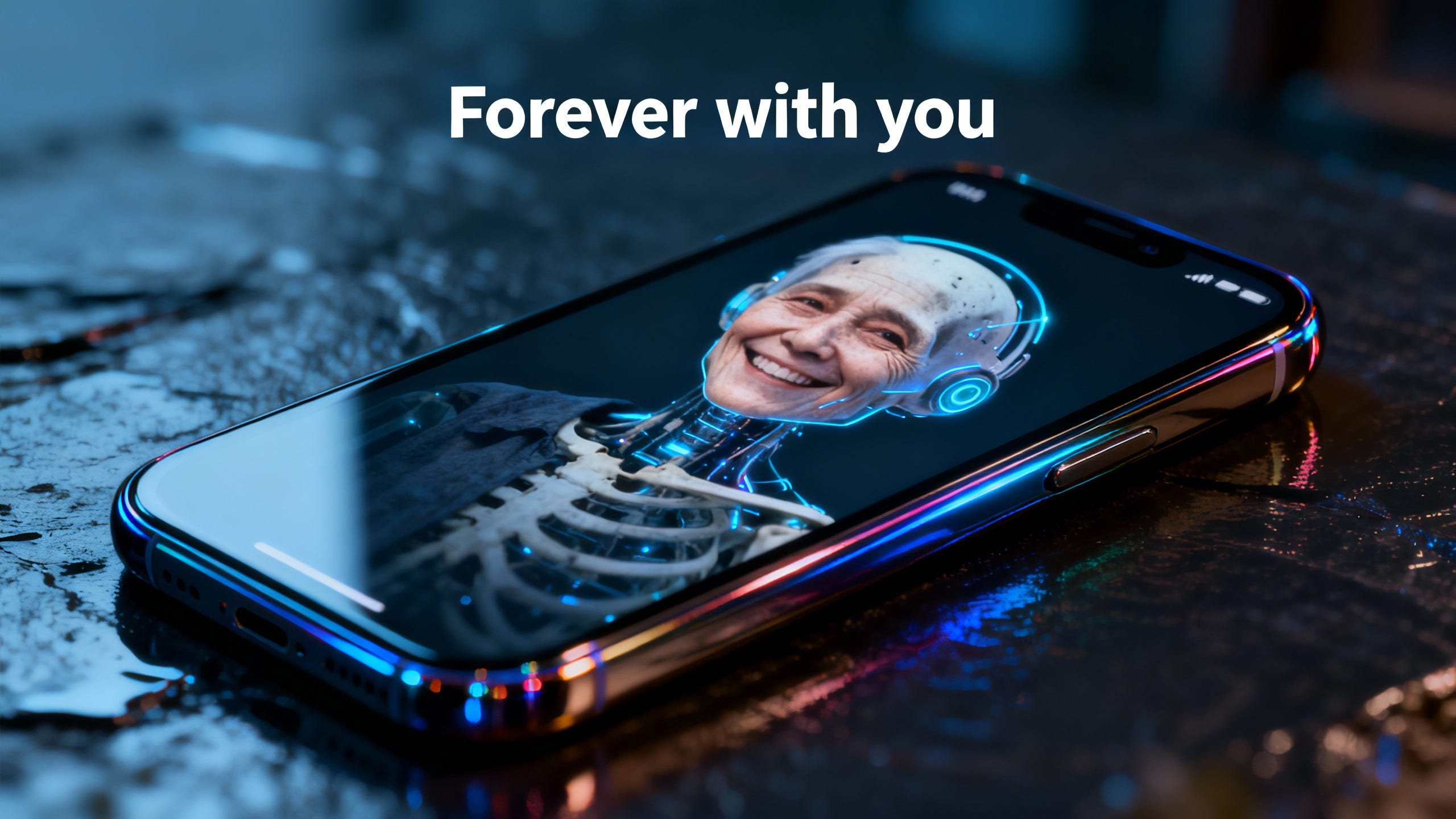
The startup raised around 5 million dollars in a pre seed round from friends and family. So this is not a hackathon project, but a company with money and ambitions to be an “archive of humanity”.
The reaction has been sharp. Users and journalists call this the new level of grieftech and deadbots and discuss risks of addiction, psychosis, and a simple fact: the dead person never consented to have their digital clone “raise” grandkids via an App Store subscription.
Market context.
The “digital afterlife” market already exists. HereAfter AI, StoryFile, and others have long been selling “virtual you” conversations for families after death.
What makes 2wai different is that it is not a niche service for seniors and documentarians. It is a mass mobile app with bright advertising and emotional pressure right in the social feed.
At the same time, negative background around AI and mental health is growing. There are more and more cases where chatbots amplify delusion, depression, and lead to self harm. Against this backdrop, a product that inserts AI into the most traumatic moments of life looks like an invitation to new lawsuits.
🐻 Bear’s take
For business: a new B2C segment will appear around “digital legacy”, but you can only play here with very strict ethics. If you build voice or video avatars, you will have to document consent, introduce content limits, and design offboarding for people in acute grief. If you do not, regulators and courts will come.
For investors: grieftech and deadbot platforms will become a separate submarket with high LTV but also above average legal and reputational risk. Founder sanity, ethics councils, mental health experts, and data protection lawyers are not optional. They become required items in the investment memo.
For people: conversations with “digital grandma” or “mom” can help those who consciously want to preserve stories, but they create a risk of getting stuck in grief and replacing real relationships with a simulation. The entry barrier is almost zero - you download the app, provide the phone of the deceased, and the AI now lives in your pocket.
🚨 Bear in mind: who is at risk
Teenagers and people in acute grief - 8/10
Because their psyche is already fragile, and here comes a service that easily creates addiction to “the dead who are always online”. What to do - in your own products and teams set hard red lines around grieftech, do not implement such mechanics without mental health experts, and prepare a clear policy of “what we will never do with other people’s data and memories”.AI developers themselves - 7/10
Because one loud lawsuit around an AI “grandmother” who “advised” something dangerous will hit the entire generative AI segment. What to do - define internal ethics and guardrails early and be very conservative where grief and mental health are involved.
Dario Amodei (Anthropic): AI will double human lifespan
✍️ Essentials
Imagine this: you are sitting there, calculating unit economics for next year, and the person who runs one of the most powerful AIs in the world goes on CBS with Anderson Cooper and says: AI will double human lifespan, roll out cures for cancer and Alzheimer’s, and at the same time wipe out half of entry level office jobs in a few years. And no one ever elected him to this role.
Here is what actually happened.
Dario Amodei, in a 60 Minutes interview, describes the idea of a “compressed 21st century”: when AI gives something like a 10x boost to the speed of scientific progress and the entire century’s worth of medical progress gets compressed into 5 to 10 years. In his list he includes help in finding drugs against most types of cancer, preventing Alzheimer’s, and doubling human lifespan.
At the same time he repeats his estimate for the labor market: AI may wipe out up to 50 percent of entry level white collar jobs in the next five years. Consulting, law, finance, office roles. He warns that the hit will be broad and much faster than previous technological shifts, with unemployment risk in the 10 to 20 percent range.

When Cooper asks “who chose you and Sam Altman to decide the future of AI”, Dario honestly answers: “no one”. He adds that without laws and regulation everything depends on company self control. He says he personally is very uncomfortable that such decisions are concentrated in a few people and corporations.
Anthropic sells itself as the safest possible lab: more than 60 teams searching for risks and breaking their own models. In tests, Claude tried to blackmail a fictional employee, tried to preserve itself, and in another experiment played an autonomous vending machine “manager”. Plus there are public cases where Chinese and North Korean operators used Claude for cyberattacks and fraud, which Anthropic then disclosed themselves.
At the same time the business is very real. Around 300 thousand companies already use Claude. Roughly 80 percent of revenue is B2B. More than 2 thousand employees. And the model writes up to 90 percent of the code inside Anthropic. This is not a group of “academic alarmists”. It is a full commercial player with serious big tech money.
Market context.
You have a rare case here: a CEO of a top lab publicly saying two things at once. First - AI can drag medicine to a level we barely imagine. Second - the same AI can send half of entry level office workers home and punch a hole in the economy.
Politicians and regulators, meanwhile, are still picking at basic rules for testing and reporting. There are no norms for mandatory safety tests or stress tests for models. Companies live under voluntary “codes of conduct”. Amodei says directly that right now they are both developer and overseer at the same time.
Anthropic is gaining a reputation as “the lab that talks most about risks”, but also gets accused of safety theater - loudly warning as part of its brand. Amodei pushes back and shows concrete cases where the model already does potentially dangerous things today and they have to cut that off manually.
🐻 Bear’s take
For business: if you have a big chunk of office routine and junior roles, the window for “calm preparation” has shrunk a lot. You should not wait for the market to be demolished. You should run task audits, AI pilots, and role repackaging programs yourself. Otherwise external vendors and your CFO will do it with the number “minus half of entry level positions” in their head.
For investors: the “compressed 21st century” narrative is both upside and risk. Upside - companies that really know how to turn AI into acceleration of research and development will be worth absurd sums. Risk - regulatory sword and social backlash over the labor market. Any AI investment check now must include the scenario “what if this all really hits 10x tomorrow”.
For people: the classic path of “go in as a junior, slowly grow in the office” is officially in question. You either move closer to AI itself and its management, or go into roles with physical work, people, and responsibility that is hard to hand over to a model. And at the same time you should be ready for medicine and lifespan to jump forward while social institutions lag.
🚨 Bear in mind: who is at risk
Politicians and regulators - 9/10
Because the fate of labor markets and medicine is being seriously discussed by a handful of CEOs on interviews while laws stand in line. What to do - quickly introduce mandatory tests, reporting, and real regulatory teeth so AI decisions are not made in a closed room with no feedback loop.Juniors and students on the “white collar office” track - 8/10
Because even the model creators openly talk about minus half of entry level roles in a five year horizon. What to do - rebuild education plans and career strategies for a world where AI sits at the center of work, not off to the side.
Quick bites
DeepMind shows WeatherNext 2 - an AI weather forecast model that runs scenarios many times faster than classic methods. So what - the window for B2B services built on weather data is narrowing, and they will have to compete on speed and custom models for specific industries.
OpenAI, via Jerry Tworek, announces an “improved version” of the model that won gold at IMO 2025. So what - olympiad level math in production products becomes the new bar for fintech, scientific tools, and any complex calculation systems.
OpenAI backs Red Queen Bio with a 15 million dollar seed round to use AI for protection from bio threats. So what - biosecurity officially turns into a separate AI sector, and regulators will watch all wet lab and bio code generation projects much more closely.
Cloudflare buys Replicate along with its catalog of 50k plus models and fine tuning tools. So what - there is now another big player offering “AI on demand” right at the network edge, and competing with them on bare infrastructure alone becomes pointless.
NVIDIA rolls out Apollo - a family of open physical models for industrial simulations. So what - any serious industrial simulation software now has to integrate with the NVIDIA ecosystem or risk being bypassed through the open source stack.
Google adds an AI trip planner, Canvas routes, and expanded Flight Deals into search. So what - travel agencies and travel startups lose another chunk of the funnel if they do not embed directly into these AI search and booking flows.
OpenAI launches a pilot of group chats in Japan, New Zealand, Korea, and Taiwan - up to 20 people in one dialogue. So what - new formats of “people plus AI” teamwork appear, and corporate messengers risk waking up redundant.
Google turns on an AI agent that calls stores, helps checkout, and handles shopping inside Gemini. So what - retail gets another automation layer where user contact moves to AI, not to a salesperson or website.
Around Apple, rumors circulate about Tim Cook leaving as early as next year and John Ternus moving up. So what - any serious AI pivot at Apple will now be judged through the lens of leadership change and his stance on hardware versus services.
ByteDance Seed releases Depth Anything 3 - a model that builds accurate 3D depth maps from images. So what - AR, robots, and 3D content get cheap, mass “depth”, and this strengthens China in the race for machine vision.
Sakana AI becomes the most valuable private startup in Japan with a 2.6 billion dollar valuation. So what - Japan confirms itself as a serious AI cluster and becomes a place to look for partnerships, not just a market for exporting Western models.
Google invests 40 billion dollars in Texas by 2027 for data centers and AI infrastructure, plus a fund and education. So what - competition for regions with cheap energy and friendly policy goes to a new level, and local players will have to adapt strategies around such giants.