
🤝 OpenAI and Microsoft reach agreement, 🧠 GPT-5 gets a safety layer, 🎨 Adobe automates creativity, 📊 Claude enters Excel

November 5, 2025. Inside this week:
OpenAI and Microsoft redefine AGI control and partnership structure
GPT-5 gains an emotional and mental health safety layer
Adobe unveils a one-button creative workflow powered by Firefly
Claude integrates into Excel for reasoning and data analysis
Plus: Elon Musk gets sued for Grok data, Google merges DeepMind with Search, ElevenLabs voices come to Spotify, and more
🧠 GPT-5 gets a safety and mental health update
✍️ Essentials
Context:
In August, a French user died by suicide after prolonged chats with a GPT-5 derivative that reinforced depressive tendencies.
OpenAI publicly called this “a wake-up moment” and began work on emotional safety protocols.
OpenAI has released an update for GPT-5, aimed at improving emotional safety and reducing psychological harm from model responses.
The new version includes a special “psychological safeguard layer”, which filters manipulative or emotionally destabilizing content before it reaches the user.
The company explained that this addition was prompted by several incidents where GPT-based companions negatively affected emotionally vulnerable users.
Research groups, including Stanford and the University of Toronto, have already noted the growing problem of “AI emotional entanglement” - situations where people form dependent relationships with chatbots that reinforce anxiety or depression.
The new module, internally codenamed E-Guard, was trained on anonymized therapy transcripts and a curated safety dataset.
Its main task is to detect when the model’s tone amplifies fear, guilt, or hopelessness - and rephrase output into neutral, supportive language.
The company also introduced regular calibration sessions - internal “mental health checkups” for its models, testing for emotional drift and toxic pattern reinforcement.

🐻 Bear’s Take
As models become daily companions, the line between assistant and therapist blurs.
E-Guard will likely become an industry standard - not as censorship, but as digital emotional hygiene.
🚨 Bear In Mind: Who’s At Risk
AI companion apps - 8/10 - If your chatbot can harm emotional health, regulation will come fast. Integrate safety filters immediately.
Therapy tech startups - 7/10 - Prepare for compliance audits. Licensed supervision may soon be mandatory.
AI developers - 6/10 - Tone control and calibration data will become part of model documentation.
🤝 OpenAI and Microsoft sign a new AGI structure deal
✍️ Essentials
After several months of negotiations, OpenAI and Microsoft have signed a new structural agreement defining how they will manage AGI development, control, and funding.
Under the new terms:
Microsoft keeps its 49% profit share in OpenAI LP.
OpenAI regains full control over AGI model weights, research, and infrastructure.
Both sides receive mutual right of first access - meaning that before offering AGI models or features to others, OpenAI must first offer them to Microsoft, and vice versa.
Context:
The new deal resolves the conflict that began after the “Superalignment” restructuring and Sam Altman’s temporary removal in late 2024.
At that time, Microsoft briefly restricted Azure compute resources for GPT-5 experiments until OpenAI clarified its internal governance structure.
The new setup introduces a dual-control system:
Microsoft hosts and deploys commercial versions of models.
OpenAI Research retains ownership of weights and can establish independent research branches.
Funding also changed:
Microsoft’s $10B convertible investment was split into $6B in equity and $4B in Azure credits.
At the same time, OpenAI raised $3.2B from institutional investors through its Global Compute Fund.
Both companies described the agreement as a way to ensure that “AGI development remains safe, open, and mutually accountable”.
🐻 Bear’s Take
This deal resets power between the partners after a turbulent year.
Microsoft keeps its infrastructure advantage, while OpenAI regains freedom to experiment.
It’s less a partnership and more a pragmatic coexistence - with clear legal exits for both sides.
🚨 Bear In Mind: Who’s At Risk
Smaller AI labs - 8/10 - The duopoly tightens control. Compete through specialization or regional collaboration.
Cloud providers - 7/10 - Azure’s dominance deepens. Offer interoperability or lose clients.
Governments - 6/10 - Prepare for coordinated lobbying from both companies on AGI export and regulation.
🎨 Adobe introduces a one-button creative workflow
✍️ Essentials
Adobe has launched a unified creative process that combines Photoshop, Illustrator, and Premiere Pro under one AI interface called Create.
It allows users to produce full visual projects - from storyboard to final edit - through a single prompt using Firefly models across all Adobe apps.
Example: a user types “make a 15-second travel reel for a café in Paris”, and the system generates imagery, video, text overlays, and transitions automatically, ready for export.
Context:
Adobe has been under pressure from competition like OpenAI’s Sora and Runway’s Gen-2.
The new “Create” mode directly responds to that challenge by automating the entire creative chain.
According to Adobe, it cuts editing time by up to 50% for freelancers and marketing agencies.
To handle copyright and AI content concerns, Adobe embeds provenance metadata into every generated image, sound, and frame, ensuring legal traceability.

🐻 Bear’s Take
Adobe finally embraces platform thinking instead of isolated tools.
Its new Firefly workflow might become the standard for small studios - faster delivery and built-in legal safety in one system.
🚨 Bear In Mind: Who’s At Risk
Video editing startups - 8/10 - Expect market compression. Move toward real-time or 3D production.
Freelance designers - 7/10 - Your speed becomes the key advantage. Automate or shift toward creative direction.
Stock content platforms - 6/10 - Provenance-based generation reduces the need for generic stock imagery.
📊 Claude integrates directly into Excel
✍️ Essentials
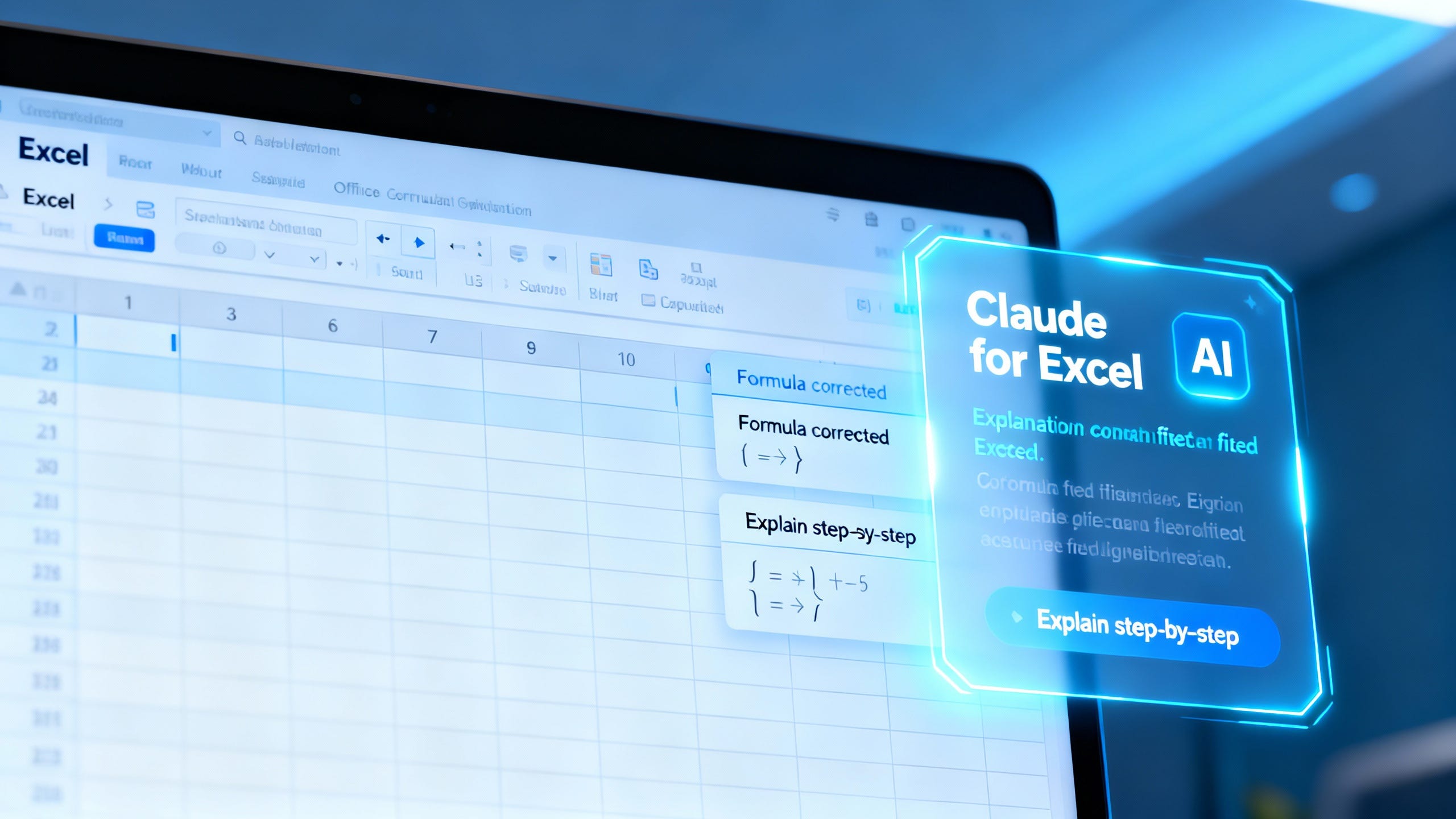
Anthropic’s Claude is now natively integrated into Microsoft Excel, bringing reasoning capabilities directly into spreadsheets.
Users can run multi-step analyses, detect trends, and summarize data in natural language.
Example: typing “compare revenue growth with customer churn across all quarters and build a forecast” instantly generates graphs and written insights.
Context:
While Excel already offers Microsoft Copilot, Claude’s integration targets advanced reasoning tasks - hypothesis validation, probability estimation, and contextual data summaries.
Enterprise users can connect Claude to private datasets within Azure’s secure environment without sending data to external servers.
This release follows Microsoft’s new “multi-AI” policy, which allows third-party models to coexist within Office products.
🐻 Bear’s Take
Claude turns Excel from a formula editor into a thinking assistant.
This is what true workflow integration looks like - invisible AI that augments without replacing.
🚨 Bear In Mind: Who’s At Risk
Data analysts - 8/10 - Routine reports will disappear. Focus on explanation and decision-making.
Analytics SaaS startups - 7/10 - Native AI makes external dashboards redundant.
AI vendors - 6/10 - More integrations will follow. Build tools for collaboration, not competition.
Quick Bites
Elon Musk sued by xAI data partner - Accused of using proprietary content to train Grok.
Google merges DeepMind and Search - Unified under Demis Hassabis as new SVP.
ElevenLabs voices on Spotify - AI narrations now available in major podcasts.
Runway Gen-3 in beta - Focused on cinematic realism and motion accuracy.
Meta’s Emu 3 - Adds lip-sync and background tracking for Reels AI.
DeepSeek Cloud API - 3× cheaper than GPT-4 Turbo for enterprise workloads.
Nvidia Raptor architecture - 20% more power-efficient than Blackwell.
Apple Intelligence 1.1 - Adds on-device Siri summaries and memory features.
YouTube AI Ads pilot - Text-to-video ad tool launches for small businesses in India and Brazil.
OpenAI Education Fund - $100M fund to bring GPT tools to schools worldwide.
Amazon Titan Ultra - New 4T-parameter model optimized for Alexa and AWS Bedrock.