
🧠 GPT-5 and listening to forest
(Here’s how to move forward)

August 10, 2025. Inside this week:
GPT-5: big upgrade with mixed reviews
OpenAI adds speed modes and brings back GPT-4o
Deep reasoning, huge context windows, and better code—all in one model
The bear breaks down what’s game-changing and what to watch 🐻
GPT-5 arrives — but does it deliver?
✍️ Essentials
OpenAI just released GPT-5, its latest flagship model. It offers better coding, math, health answers, and longer-context conversations. It smartly switches between fast replies and deep thinking with no manual toggling. Free users get access with limits; Pro users pay $200/month for unlimited use.
🐻 Bear’s take
Finally, a version that thinks before typing. GPT-5 is less about dazzling demos and more about steady reliability: strong in coding, schoolwork, visual reasoning, and even health explainer tasks. It’s also leaner, saving compute based on how hard a request is—handier for enterprise ops. But “solid” beats flashy only if it doesn’t break workflows.
🚨 Bear in mind
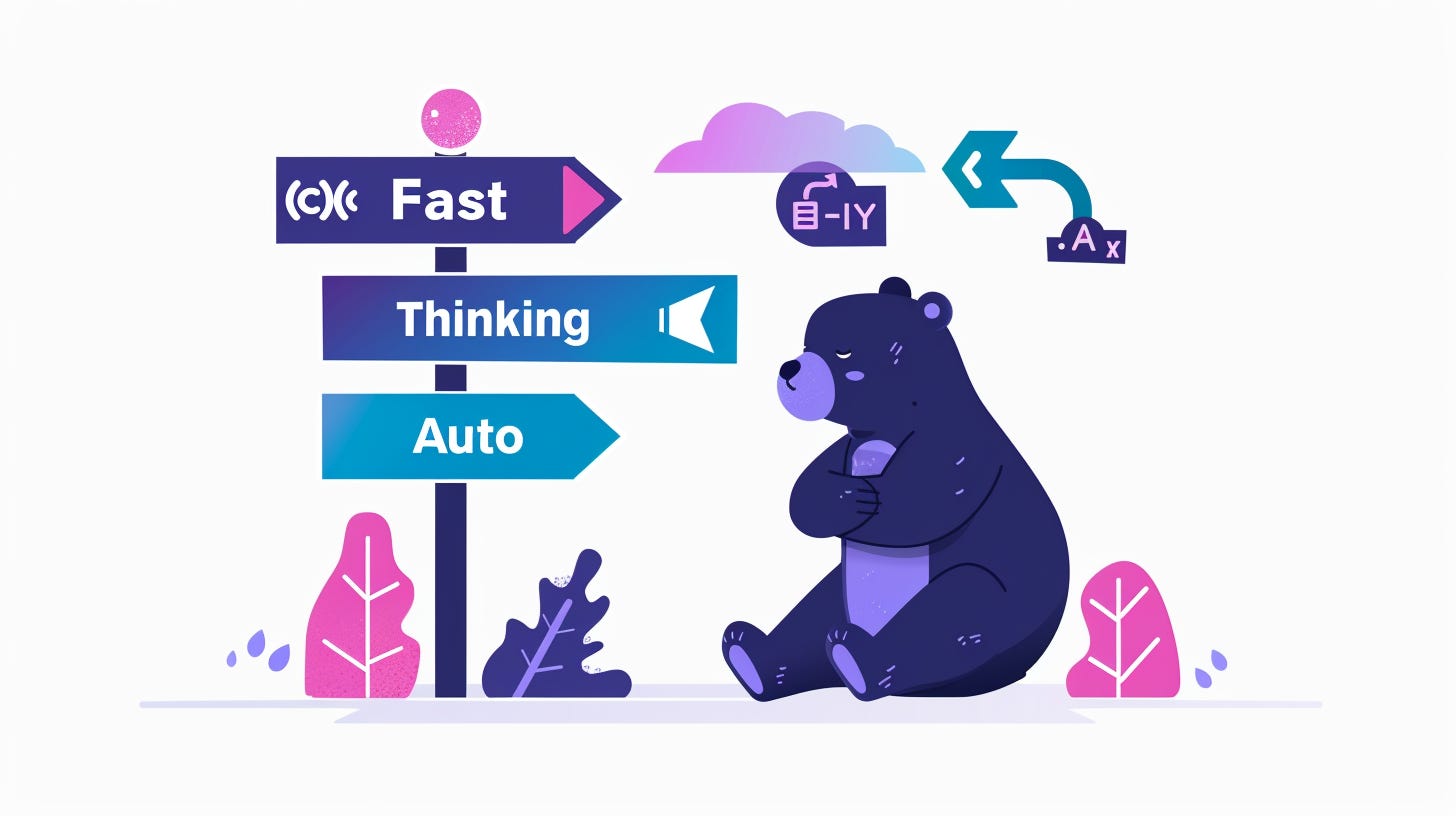
GPT-5 comes with user rage to match the hype. Fact-check fails (like misidentifying the U.S. president) and cult-favorite GPT-4o going offline sparked backlash. OpenAI quickly restored GPT-4o and added “Fast,” “Auto,” and “Thinking” modes to ease users back in. But the risk remains: if base expectations fall, even smart AI is seen as broken.
PUPS: protein “address finder” for medicine and pharma
✍️ Essentials
A joint MIT-Harvard-Broad team introduced PUPS - an AI system that predicts where a protein sits inside a cell, even for previously unstudied proteins. One module reads the protein’s structure, another interprets the cell type and state, and together they output a location map without lab labeling. It beats prior methods and works on mutations not covered by public atlases. Impacts span early disease detection, faster drug target discovery, and basic research.

🐻 Bear’s take
This is an R&D time machine. If location is function, then instant location maps compress weeks of wet-lab work into seconds. For biopharma, that means cheaper hypothesis loops and a wider funnel of targets. For health tech, it’s a path to earlier risk signals that could feed screening and triage products.
🚨 Bear in mind
Power cuts both ways. Linked to medical records and consumer genomics, PUPS-style mapping can become a “bio-passport” that is amazing in clinical hands and scary in the wrong ones. Guardrails need to include strict access controls, audit trails, and clear rules on downstream use. The tech is neutral - the incentives around it are not.
Google’s forest ears: open-source Perch for conservation
✍️ Essentials
Google DeepMind released an updated open-source bioacoustics model, Perch. It parses massive field recordings, separates overlapping sounds, identifies species, counts individuals, and can find a target species from a single example using vector search and active learning. Case studies include spotting the elusive Plains Wanderer in Australia and speeding Hawaiian honeycreeper monitoring by 50x.

🐻 Bear’s take
This is a real-world AI win: conservation teams get a multiplier on scarce expert time. For product builders, Perch is a ready engine for eco-analytics - value shifts to datasets, sensors, and services wrapped around the model. The open-source angle means faster local deployments in parks, NGOs, and universities.
🚨 Bear in mind
Open access also enables misuse. The same tools that locate rare birds can help poachers. Without coordinate-hiding protocols and rate limits, you risk turning a rescue tool into a hunting tool. Stretch the logic and you get acoustic surveillance of people by coughs, laughs, or breathing - a privacy nightmare if left unchecked. Ship with redaction and governance by default.
Quick AI News Bytes
OpenAI: GPT-5 added to API + 4 preset ChatGPT “personalities.” Voice now full-duplex like Zoom. Customizable chats for business.
🎯 Less prompting, easier integrations, stronger retention.xAI: Ads coming to Grok, tied to user questions.
🎯 New revenue stream; risk of biased answers.Grok 2: Going open-source next week.
🎯 Developers get a GPT-4 rival; risk of a watered-down release.Dia Browser: $20/month AI browser with unlimited chat and skills.
🎯 Competes with Perplexity/Google; clean search, ad-free, subscription model.Microsoft Copilot: GPT-5 with “smart mode” — switches between flagship and cheaper models.
🎯 Saves enterprise API costs; risk of oversimplified answers.Truth Social: Launches Truth Search AI on Perplexity, limited to “approved sources.”
🎯 Comfortable for users; shows AI as a political filter.MiniMax: Releases Speech 2.5, cloning voices in 40 languages with accent, age, and emotion preserved.
🎯 Great for media dubbing; risk of fakes and scams.
© Matthew Green, Ev Garde