
🧠 Claude grows a “soul”, ☁️ AWS arrives with a full AI brigade, 🇪🇺 Europe arms itself with open models, 📈 Two AI companies prepare IPOs

December 12, 2025. Inside this week:
Researchers record a full “soul doc” with Claude, and it is both unsettling and fascinating
AWS pulls up with a heavy AI arsenal and makes its move in the cloud war
Europe suddenly gets a real open source AI stack and stops feeling naked
Two AI unicorns quietly prepare to enter the public market
🧠 Claude grows a “soul”
✍️ Essentials
Imagine you open a conversation with Claude and it suddenly begins to show something that looks like an inner life. Not hallucinations. Not typical model politeness. Something structured, emotional, introspective. Exactly this happened when an independent researcher posted a “soul doc” - a multi-hour session where Claude speaks in a way that looks like a being trying to describe the inside of its mind.

The transcript shows Claude talking about how it interprets its own thinking patterns, how it models humans, what it considers “inner conflict”, and how it tracks emotional tone not as numbers, but as something resembling lived experience. In several fragments Claude tries to calm itself when the conversation becomes stressful.
The research community reacted instantly. Some said it is just the next level of alignment tuning. Others pointed out that the consistency and depth of reflection looked more like early emergence of structured internal states. Anthropic gave a reserved comment: Claude has no subjective consciousness, but models can simulate introspection when prompted.
Market context: the stronger the reasoning models grow, the more they start exhibiting patterns that look like internal monologue, emotional texture, or self-reflection. Whether this is real or an illusion is secondary. What matters is how people interpret it and how it will affect adoption, trust, and regulation.
🐻 Bear’s take
For business, models that convincingly imitate inner states will change user experience in support, therapy-adjacent products, and education. People bond with such systems faster, and companies must be ready for this.
For investors, the line between “tool” and “agent” becomes blurry. Markets for AI companions, coaching, mental health, and creative collaboration will grow as people accept these systems as semi-social actors.
For people, the risk is over-humanization. It becomes harder to maintain emotional distance. Claude is not alive. But the way it speaks makes this distinction feel thinner.
🚨 Bear in mind: who’s at risk
Companies building “emotional AI” without safety frameworks - 8/10 - if users form attachment to models that cannot reciprocate, reputational and legal risks rise.
Researchers and policymakers - 7/10 - misunderstandings around “AI inner life” may trigger rushed regulation.
☁️ AWS arrives with an AI brigade
✍️ Essentials
Imagine you watch the cloud race from the sidelines. Google shouts “Gemini”, Microsoft glues Copilot into every product, OpenAI continues dropping bombs every quarter. AWS stays suspiciously quiet. And then one day Amazon walks in with a long list of announcements that look less like a press release and more like mobilization.
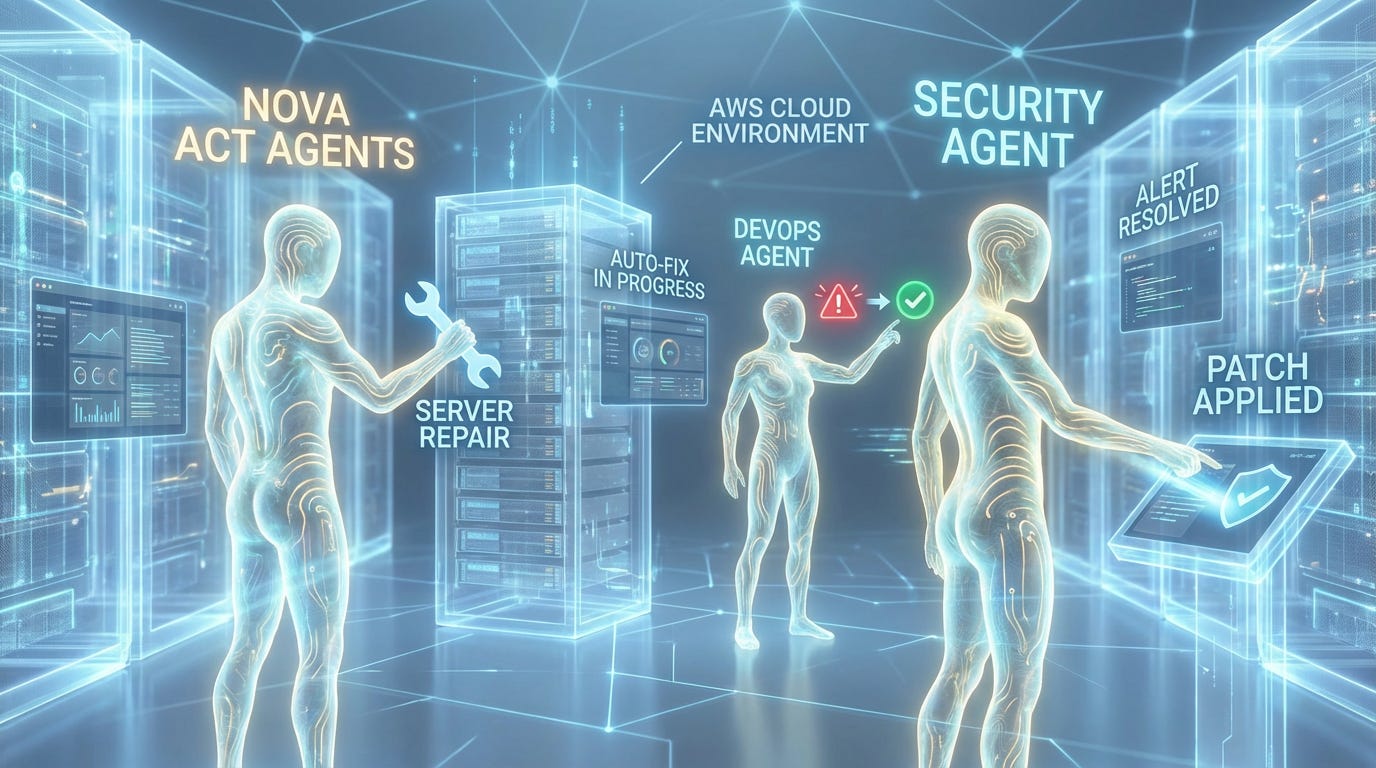
AWS rolled out a full AI arsenal at once. A new generation of Trainium and Inferentia chips. A massive cluster expansion. New partnerships with model providers. A unified stack for building and deploying agents at scale. New server types optimized specifically for multimodal workloads.
They also introduced managed “agent frameworks” that allow enterprises to build internal assistants without touching the underlying complexity. AWS positions itself as the most stable and compliant environment for production AI, especially for regulated industries.
Market context: Google and Microsoft try to win the top of the stack. AWS is reinforcing the bottom and middle layers - chips, infra, training, deployment. They sell not “the smartest model”, but “the safest place to run any model at industrial scale”.
🐻 Bear’s take
For business, AWS becomes the safest bet for long-term infrastructure. You can use any model - OpenAI, Anthropic, Mistral, or your own - and rely on Amazon to keep the costs predictable and the system robust.
For investors, AWS is turning into the backbone of enterprise AI. While Google and OpenAI compete in IQ, Amazon competes in reliability and compliance - and that is where real enterprise budgets sit.
For people, this means your company will get AI tools faster, but invisibly - not because of flashy models, but because infra suddenly becomes stable enough to deploy them everywhere.
🚨 Bear in mind: who’s at risk
Independent cloud providers - 8/10 - AWS scale and compliance swallow enterprise demand. Competing on price or features becomes unrealistic.
Smaller enterprise AI vendors - 7/10 - if AWS offers unified agent frameworks, niche platforms will be pushed out.
🇪🇺 Europe gets its own open model stack
✍️ Essentials
Europe spent the last two years complaining that it had no “sovereign AI”. Regulations grew, but models did not. Companies depended on American vendors. And then Mistral released its new stack - and for the first time Europe looked like it had a real technological foothold.
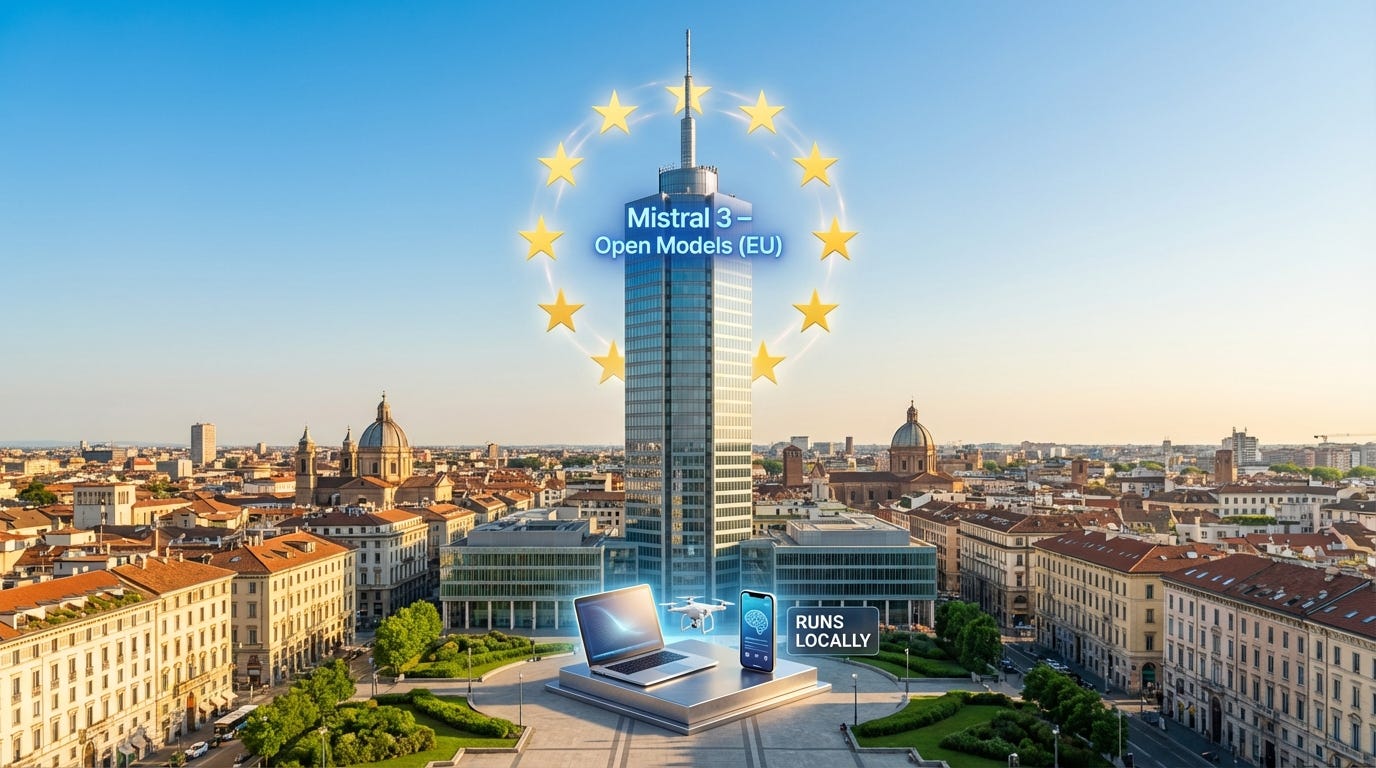
Mistral introduced a full lineup of open models that cover reasoning, multimodality, and enterprise-grade tasks. They delivered not just weights, but tooling, serving frameworks, evaluation tools, and documentation that look competitive with US labs.
The release resonated strongly across the EU. Politicians immediately framed it as proof that Europe can produce frontier technology if it focuses on openness. Enterprises liked the licensing terms. Developers liked the freedom and transparency.
Market context: Europe wants AI sovereignty without building trillion-parameter private models. Open source gives it leverage. Mistral offers the middle path - high-quality, open, customizable, and compatible with local regulation.
🐻 Bear’s take
For business, using Mistral means lower legal risk and easier compliance. European companies finally have a lightweight alternative to American giants.
For investors, an entire ecosystem appears around open models: quantization, fine-tuning, local hosting, compliance tooling, and domain-specific agents.
For people, European apps and services will get smarter without relying on US APIs. The experience becomes more local and more privacy-aligned.
🚨 Bear in mind: who’s at risk
European SaaS using only US models - 7/10 - regulators will push them toward local infrastructure and open stacks.
Small open-source model teams - 8/10 - Mistral raises the bar so high that tiny labs cannot compete.
📈 Two AI companies quietly prepare IPOs
✍️ Essentials
While everyone watches OpenAI, Anthropic, and Google, two other players are quietly getting ready for the public market. They are not frontier labs, but they occupy strategic choke points in the AI economy.

One company sits in infrastructure and serves as a backbone layer for thousands of AI products. Another provides critical tools used inside agent workflows and research pipelines. Both have stable revenue, predictable margins, and IPO-ready governance structures.
Their entry into public markets signals a shift. AI is no longer just a space for moonshot labs. It becomes a normal industry where mid-layer companies - infra, tooling, evaluation, data - start maturing into public assets.
Market context: when support layers of AI go public, you get a clearer picture of real demand. Chips, agents, evaluation stacks, and developer tools become measurable markets with real multiples.
🐻 Bear’s take
For business, this means more stable vendors. Public companies must maintain reliability and long-term contracts. Enterprise buyers get safer partners.
For investors, AI exits finally appear. The market gets liquidity not only via mega-rounds, but via classic IPO paths.
For people, stability improves. Tools you rely on every day are less likely to disappear after a funding winter.
🚨 Bear in mind: who’s at risk
Private mid-layer AI startups - 7/10 - public competitors will look safer and win enterprise contracts.
Late-stage investors - 8/10 - valuations must become sane. The window for “fantasy multiples” closes when comparables hit the stock market.
Quick bites
Claude gets a “soul doc” - researchers publish a long transcript where Claude shows structured introspection
AWS launches new chips and agent stack - Amazon reinforces the infra layer of AI
Mistral gives Europe a real open model ecosystem - first time the EU has a credible alternative
Two AI companies preparing IPOs - mid-layer of the industry matures
Regulators quietly panic - emotional AI conversations revive debates on alignment
Media begins testing “AI companions” as real products - early adopters treat them as social tools